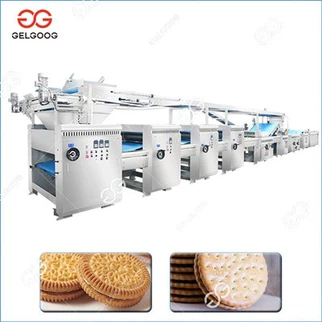
How are biscuits made in a factory? Commercial biscuit manufacturing is a continuous process that combines ingredient preparation, dough processing, forming, baking, cooling, and packaging. The equipment configuration depends on the biscuit type, production capacity, recipe, and required product specifications.

Biscuit Production Process in Factory
1. Ingredient Mixing and Dough Preparation
Production starts with accurately weighing and mixing the ingredients. Flour, sugar, fat, water, and other ingredients are processed in an industrial dough mixer to achieve consistent dough properties.
For hard biscuits, the dough can be processed through a dough sheeter and gauge rolls to gradually reduce its thickness. A laminator can also be integrated when the product requires a layered structure.
2. Biscuit Forming
Once the dough reaches the required thickness, a rotary cutter cuts it into individual biscuit pieces. The cutting mold determines the product's shape, dimensions, and arrangement on the conveyor.
For soft biscuits and molded products, a rotary moulder can be used instead. It forms the dough through engraved molds and allows different patterns, shapes, and product specifications.
At this stage, understanding how are biscuits made in a factory also means considering how forming equipment matches the dough characteristics. Different formulations may require different forming methods, and the forming speed must be coordinated with the downstream oven capacity.

3. Continuous Baking
The formed biscuits enter a tunnel oven for continuous baking. Industrial tunnel ovens generally contain multiple heating zones, allowing temperature and baking conditions to be adjusted throughout the baking process.
Baking parameters depend on biscuit thickness, moisture content, formulation, and target color. Conveyor speed and temperature control need to work together to maintain consistent baking results across the production line.
4. Cooling and Packaging
After baking, the biscuits pass through a cooling conveyor before packaging. Sufficient cooling time allows the product temperature and moisture to stabilize.
The packaging section may include a biscuit stacking machine, counting system, metal detector, and flow-pack machine, depending on the required packaging format and production capacity.
What Determines Biscuit Production Capacity?
Production capacity cannot be determined by the oven alone. Forming width, cutter speed, oven length, conveyor speed, and packaging capacity all need to match.
For example, a line designed for 500 kg/h will require a different configuration from one producing 1,000 kg/h. Biscuit size, individual weight, recipe, baking conditions, and available factory space also influence equipment selection.
Therefore, how are biscuits made in a factory is closely related to how the entire production system is configured. Each machine of automatic biscuit production line needs to maintain a stable material flow and match the requirements of the next processing stage.